Review: Christians and Pagans in the City
Paganism often evokes thoughts of pantheons of gods, sacrifices, priests, priestesses, and high ceremony. Zues and Venus, or the days of the week, might come to mind. Christianity, on the other hand, is often associated with more austerity. Even “high church Christianity” doesn’t match the wild experiential experience of pagan religions.
Paganism also evokes a sense of “the old,” something societies have left in the distant past.
But is paganism really in the past? It depends on how paganism is defined. If paganism is a specific pantheon of gods connected to a set of rituals, it is true there are very few who worship the “old Roman pantheon” today. But paganism is more than a particular pantheon of gods; it is also a worldview.
According to Steven Smith in Pagans and Christians, the essence of this worldview is making the physical world sacred—or rather, sacralizing the immanent. Smith argues Christianity represents the opposite of this worldview. Christianity holds God is transcendent, outside physical space. Rather than being a “person writ large,” God is something “other.”
Two points might help readers understand this review a bit better.
First, the author often “works to the edges,” making space between these two worldviews by emphasizing their differences. This is very helpful, but readers should not forget that there is a range of belief in Christian circles. All Christians hold God is transcendent, but the closer a given Christian theological system comes to its Jewish roots, the more likely it is to hold God is both transcendent and immanent.
Second, there are two senses in which the physical world can be sacred. To fully understand the author’s argument, readers need to be careful to differentiate between them. For Christianity (and Judaism) the physical world is sacred to God because God created it, sustains it, and is present in it. In this view, the physical world is a means to some end, sacred in proportion to the end being sought.
In Paganism, however, the gods are part of the physical world. The physical world, and the desires of the physical world, are an end in themselves. If the physical world is somehow destroyed (not just the Earth, but the entirety of physical existence), the gods would cease to exist as well.
In Smith’s telling, Paganism dominated the world before the rise of Christianity. The natural focus of Paganism is its pantheon. There were gods for places, like hills and streams. There were gods for things, like swords and buildings. There were gods for activities, like eating, cooking, war, and—the big elephant in the room—sex. Because of this, there were gods at every corner in the city, and at every turn of the road in the natural world. The world, as it were, was full of gods.
Paganism centers the ideas of right and wrong in the physical world—the desires of and thoughts of the gods. If the “god of this mountain” is ascendent, what the “god of this mountain” thinks or feels about anything sets the ethical rules. A culture that draws its meaning from the world draws its ethical framework from the world.
The rise of Christianity, according to Smith, desacralized the world. The obvious effect is the gods are no longer “everywhere.” The less-than-obvious effect is people no longer draw their meaning from the world, but from God, who is—although present in the world—outside the world.
The shift from drawing meaning from the physical world to God outside the physical world is radical. Two areas the author describes, but does not call out explicitly, are perhaps the most important examples of this shift.
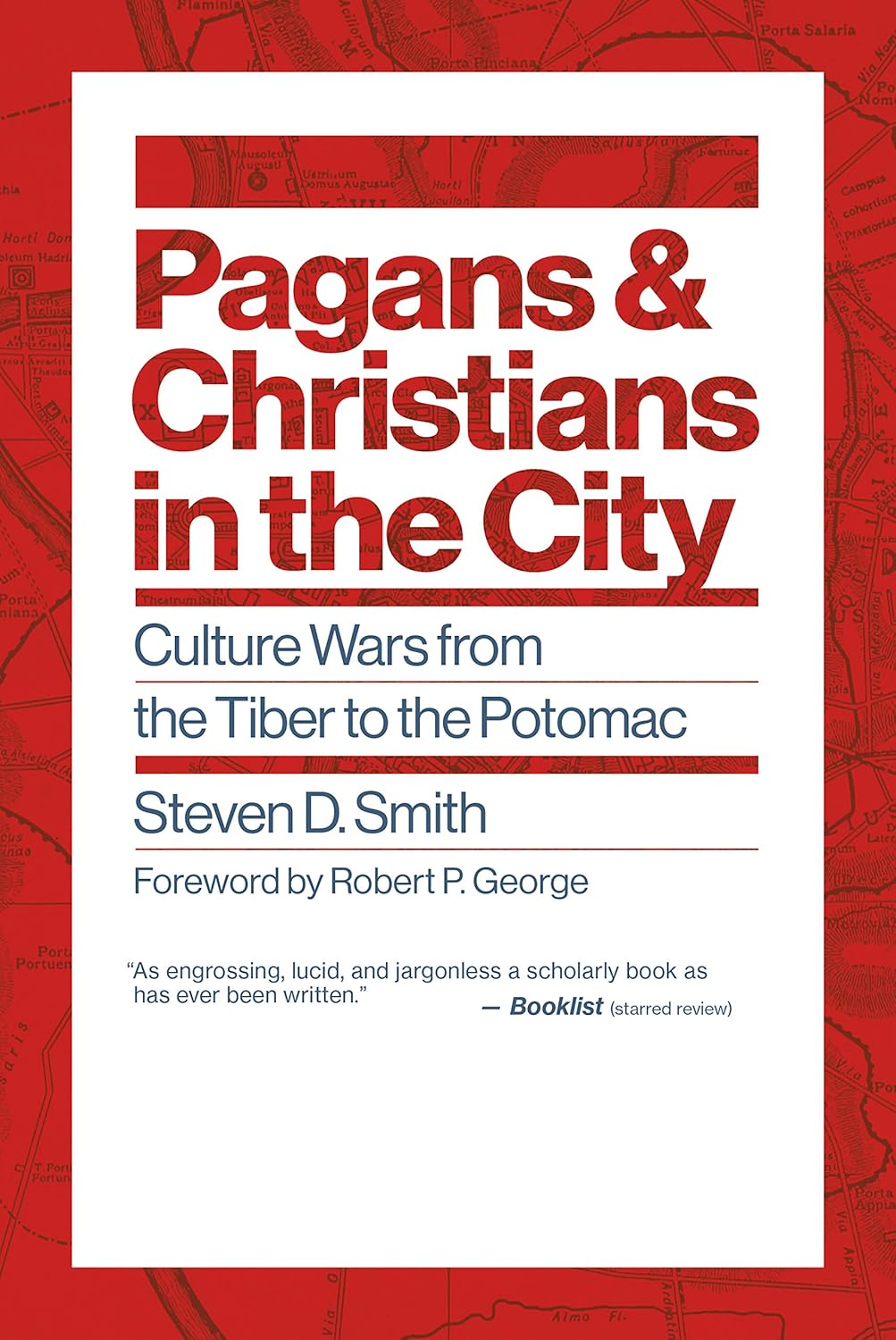
Smith, Steven D. Pagans and Christians in the City: Culture Wars from the Tiber to the Potomac. Eerdmans, 2018.
Roman culture was focused on male sexuality. The entire moral and ethical code, from slavery to worship to marriage, was built around the male sexual act. Rome treated male desire as sacrosanct and involatile. Male sexuality could be openly and publicly displayed and was honored by all of society.
Christianity, on the other hand, desacralized sex. Like any other act, sex was an act that could be sacred in the right context, and evil in others. Christianity treats monogamy as sacrosanct and involatile.
For Romans, fulfilling male desire was an end-in-itself. For Christianity, the sexual act is aimed at producing higher things, such as children and relationship.
These different views of sexuality led to differing views of human dignity.
Paganism tied human dignity first to the male sexual act, and second to worldly success. Christianity ties human dignity to a relationship with God.
Smith argues that while the gods of the old Roman pantheon have fallen to the side, the foundational pagan worldview has lived side-by-side with Christianity for the last two-thousand years. While the Christian view has dominated our view of law and dignity, the pagan view has lived on as part of most peoples lived experience. Marriage itself has been sacrosanct rather than the sexual act. People are expected to control their desires and actions out of respect for the dignity of others.
As Christianity has receded in the last hundred or so years, however, Smith says the pagan view (sans the pagan gods) is moving into a controlling position again.
What might we expect if the author is right? Consider a few examples.
The sexual act would be re-sacralized, becoming the goal and point of relationships, including marriage. Sex would be everywhere, all the time, and people would rate their importance and dignity on the number and quality of their sexual partners.
Material success and experience would be re-sacralized. Dignity would be tied to material success. This would not be restricted to being financially successful but would extend to experiences. People would focus their lives on living as comfortably as possible and experiencing as much as they can through their lives. He who dies with the most toys would, in fact, “win.”
Childbearing, in that it interferes with material success, sexual desirability, and sexual availability, would be a center of attention. How can you avoid childbearing? Even if someone wants to have children, how they can minimize the number of children to maximize the other areas of their lives?
An observer who cannot see these things happening in Western cultures everywhere over the last fifty to one-hundred years is simply blind.
There are two major differences between Roman paganism and the modern pagan worldview that make this movement a bit harder to see. First, while the pagan worldview is returning, the pagan gods are not. Instead of worshipping a “god” representing the thing, Western culture has taken to openly worshipping the thing itself.
Second, Roman paganism made male sexuality sacred, demeaning the passive partner in the sexual exchange. The male in the male-female sexual act determined the time and place, circumscribing the ethical boundaries of his partner’s actions. The receiver of the sexual act, whether male or female, was effectively an “accessory.”
The modern pagan worldview, on the other hand, makes female sexuality sacred in the male-female sexual act. The female controls the time and place, circumscribing the ethical boundaries of the male.
The importance of the return of the pagan worldview can hardly be overstated. Tying dignity to material success enables and emphasizes the financialization of everything. Relationships are no longer sought for the good of the other person, nor the relationship itself. Relationships are pulled through an app, measured, tracked, and focused on either gaining money or experience. Work is only a source of dignity in proportion to its financial aspects. Any desire that can be tied to sex is immediately declared ethical—so long as it does not transgress on the female’s desires in the moment.
If the trend towards paganization continues, the societal results will be ever-more profound.
According to Smith, the pagan worldview cannot help but to be “at war with Christianity.” While Christianity can tolerate, to one degree or another, a pagan cultural subtext, a pagan culture cannot, in any sense, tolerate Christianity or Judaism.
Overall, the author does an excellent job of drawing out the foundational worldviews underlying Roman paganism and Christianity. These observations will help readers understand the cultural shifts happening in the modern world and how to relate to them.
Well worth reading.