Salvation, Active and Passive
One important argument for deterministic predestination to salvation is passages where salvation is spoken of as a passive event. For instance, in 1 John 5:1, we find—
Everyone who believes that Jesus is the Christ has been born of God…
The latter part of this sentence, “has been born of God,” is clearly passive. Being born of God is not something the believer does, but rather something God does. At first reading, this certainly sounds like salvation is wholly God’s doing, and the doctrine of total inability (humans are unable to even seek after salvation without God changing their hearts first).
The immediate reading, however, appears to conflict with the many offers of salvation found throughout the Scriptures. For instance, in Acts 16:30–31, we find—
Then he brought them out and said, “Sirs, what must I do to be saved?” And they said, “Believe in the Lord Jesus, and you will be saved, you and your household.”
These many passages infer the person must take an active role in their salvation by placing their faith in Christ. This is not just found in the writings of the Apostles, either. There are many passages in the Tanakh where God openly says that if certain people, or Israel, will place their faith in him, he will provide some form of salvation.
How can these two different kinds of passages be reconciled? Perhaps we can find an answer by looking at the rest of the passage, specifically the words, “Everyone who believes…” Rather than looking at the whole passage in a translation, however, let’s look at it in Greek.
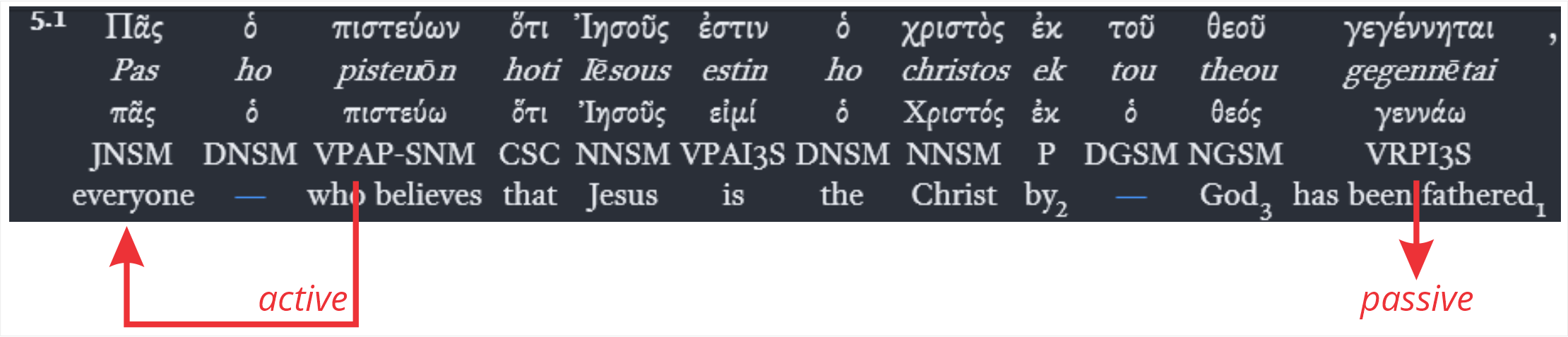
There are two verbs here, rather than one. The first verb, believes, is coded as:
- V, verb
- P, present
- A, active
- P, participle
The second verb, glossed as has been fathered, is coded as:
- V, verb
- R, perfect
- P, passive
Because the first verb is a participle, we know it modifies something—in this case, the subject, which is everyone. Because the verb is active, we know that whoever this verb modifies actively takes part in, or does, the thing described. So we can read this part of the passage: “Everyone who actively believes Jesus is the Christ…”
For those who actively do what is described in the first part of the sentence, the second part of the sentence will apply. They will be “born of God.” This passage, then, does not teach that salvation is an entirely passive affair. If a person actively places their faith in Christ, then God will give them salvation.
Where is the problem?
First, a problem will arise if we assume the passive from the second part of the passage must, somehow, apply to the subject, everyone. Many who hold to predestination note believe is a participle, correctly note it “only” modifies some other word in the sentence, and hence apply the passive tense of the second part of the passage to the first.
This does not make grammatical sense, however. The participle does “just describe” something about everyone—it describes how everyone does the thing described. In other words, the participle describes how everyone believes. Their belief is active.
Second, a problem will arise if we now try to inject some other question into the text. For instance, many who hold to deterministic individual predestination will then ask: “But why did they believe?” Presupposing the answer to be “because God has changed their heart,” inevitably leads to the deterministic conclusion.
But the passage does not ask or answer this question. How someone among the everyone comes to believe is not something addressed by the passage at all. Trying to force this passage to answer a question it does not answer is a certain recipe for exegetical disaster. The very framing of the question presupposes a desired outcome.
If anything, the passage infers those among the everyone who do believe do so out of their own desire or volition.
These failures should point us to two lessons.
First, pay attention to all of the passage. The active voice of the first part of the passage is clear even in the English translation. Rather than simply discarding or passing over that active voice verb for the second, passive voice verb, we must spend time and effort trying to understand what each of these verbs does in the context of the whole. We need to seek what the author is trying to say, rather than what we would like the author to say.
Second, do not ask questions the passage does not answer, particularly as a form of injecting a false dichotomy.
Deterministic individual predestination requires believing there are things the Scriptures do not say, or that God uses “round-about” language. If God meant for the act of belief, itself, to be understood as passive, the Greek in 1 John 5:1 would have believe in the passive voice. It does not, so belief is not passive.
Salvation, according to 1 John 5:1 (and similar passages), is simple.
A person actively places their faith in Christ. God then actively changes the person who believes so they are now born of the Father. The person placing their faith in Christ is not a work, as the merit is all on the side of God, who does the work of changing the person.