22: Healing of the Paralytic
On one of those days, as he was teaching, Pharisees and teachers of the law were sitting there, who had come from every village of Galilee and Judea and from Jerusalem. And the power of the Lord was with him to heal. Luke 5:17
Luke introduces us to the Pharisees and “teachers of the law”—elsewhere called the Scribes—in this passage. Who are these people, and why do they care so deeply about Jesus’ teaching? Let’s look at some reasons why the Pharisees cared so deeply about Jesus’ teaching.
First, according to Pharisaical teaching, God had cast Israel out of the Land because they had not fully followed the Mosaic Law, specifically via syncretism.[1] The Pharisees, then, considered teaching the Law and finding ways to help people keep it to be supremely important, as it prevented the people from adding various religious practices and ideas to Judaism.
They worked towards these goals by building a series of “fences” around the Law. While there is a clear distinction between committing a sin and becoming ceremonially unclean, the Pharisees largely saw things a little differently. Avoiding sin begins by avoiding ceremonial uncleanness; fences are built to prevent it. One well-known example of this is:
- It is sinful to offer sacrifices to an idol.
- One specific prohibition is never to boil a calf in its mother’s milk—apparently a common practice among the pagan religions in the Land before Israel’s arrival.
- Because you cannot tell if a particular bit of dairy is from the mother of the cow from which a particular piece of meat came, and the stomach “boils” the solids in the liquids you eat, you should not eat meat and dairy products at the same time.
The Pharisees held that adhering to these fences would make intentional sin visible, and reduce unintentional sin, reducing the likelihood that God would remove Israel from the Land (again).
Antiochus Epiphanes’ attempt to force Israel to worship the Roman gods in the 160s B.C. gave the movement to preserve Israel’s righteousness significant momentum. From that time forward, Pharisees (and other Jewish groups) resisted cooperating or even interacting with secular governments.
Second, the Pharisees held that God will preserve a nation if he could find some number of righteous people there. They took this view—a view that is still taught among various Jewish groups to this day—from the discussion between God and Abraham at the Oaks of Mamre. They supported this view from God’s statements to the various prophets about a righteous remnant through which God would save Israel.
They aimed to be that righteous remnant through separation and strict adherence to the Law and the fences. According to Geldenhuys, the name Pharisee “is probably derived from the passive participle of the Hebrew verb pārash (פָּרַשׁ), which means ‘to separate.'”[2]
Third, the Pharisees held the Messiah would return as a military leader to free Israel from Roman rule, rebuilding Israel as God’s witness to the world. It was unthinkable that Israel should be removed from the Land yet again; God’s name would be dishonored in all the nations.
Fourth, the Pharisees held that entrance into Abraham’s Bosom—essentially a Jewish vision of what Christians might call “heaven”—was regulated via circumcision.[3] Jesus threatened this model by teaching that faith, rather than circumcision, is the necessary prerequisite to salvation.
Based on these things, it’s easy to see why the Pharisees would be very concerned about Jesus’ teaching. If Jesus led people astray, into thinking infractions of the Law were minor or the Pharisees’ fences were of no import, God could well remove Israel from the Land, which would be an unmitigated disaster.
Now let’s turn to the paralytic’s healing.
And behold, some men were bringing on a bed a man who was paralyzed, and they were seeking to bring him in and lay him before Jesus, but finding no way to bring him in, because of the crowd, they went up on the roof and let him down with his bed through the tiles into the midst before Jesus.
Luke 5:18–19
You may see, in your mind’s eye, a modern house. Jesus is sitting in the living room when the ceiling opens just in front of him, and a basket in the shape of a stretcher is lowered from the ceiling. Or perhaps you’ve puzzled over the idea of a “tile roof” that you must “dig through” (combining Luke’s and Mark’s descriptions). We can resolve this mystery by considering the following illustration of one way houses were built in Israel at this time.
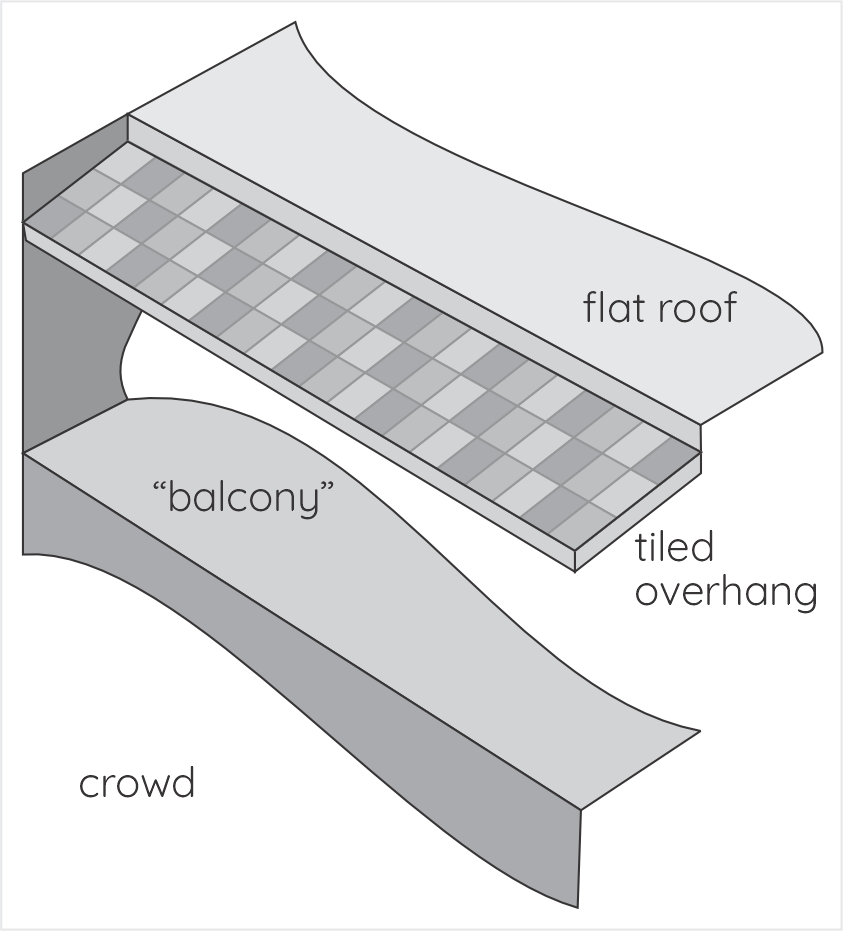
Some houses had a sort of “balcony” on the upper floor looking out over a large, open courtyard. Jesus would be sitting on this balcony, speaking to the people crowded into the courtyard below. If this were a large house, then perhaps fifty or sixty people might be crowded there.[4]
The men, seeing the courtyard impassable, take the man up to the flat roof of the house, pull the tile off the small overhang, and lower him down so he is on the balcony with Jesus. While digging through the flat roof would cause permanent damage (potentially even causing the house itself to collapse), removing the tiles from an overhang like this would leave no permanent damage.
And when he saw their faith…
Luke 5:20
How did Jesus see their faith? Because they acted on it—they found a way to bring the man to Jesus’ attention (bringing him “before his eyes”), and they acted on it. While faith is a noun here (the first use of faith as a noun in Luke), this faith is active. The men did not wait until Jesus was more accessible, not busy, or “called”—they saw the situation and actively sought God out to resolve the problem.
…he said, “Man, your sins are forgiven you.”
Luke 5:20
While not all physical disease is a result of sin, Jesus apparently saw that this particular paralysis was, and hence the best path forward was to forgive the man’s sin. Forgiveness would lead to physical and spiritual healing.
And the scribes and the Pharisees began to question, saying, “Who is this who speaks blasphemies? Who can forgive sins but God alone?”
Luke 5:21
While there are instances in the Tanakh of God calling on people to forgive those who have sinned against them, there is no instance of a priest or prophet forgiving a sin against God or against a third party. Because of this, the Pharisees held you can forgive sin committed against you, but not forgive a sin against God or a third party. Only God can do this.
Jesus is claiming to forgive the sin of this man, either against a third party or against God, so Jesus is claiming to be God. Everyone who says, “Jesus never claimed to be God,” clearly hasn’t read the Pharisee’s reaction to Jesus’ words in this passage.
Some writers classify Jesus’ forgiving sins against God or some unknown third party as a Messianic Miracle—something only the Messiah can do.[5]
… But that you may know that the Son of Man has authority on earth to forgive sins …
Luke 5:24
It is easy to say: “Your sins are forgiven.” It is much harder to prove the man’s sins are actually forgiven. Given the connection between sin and physical maladies in his listeners’ minds, Jesus goes directly to physical proof.
The Son of Man is a circumlocution for “God,” referring back to Daniel 7:13. Jesus’s use of “man” in Luke 5:20 creates a play on words between these two statements, drawing them together in his listeners’ minds.
At least some of the Pharisees, at this point, know precisely who Jesus is claiming to be. The question is not who Jesus claims to be, but rather what to do about it. Could it be true that the Messiah has come in a way they did not expect? For some Pharisees, their understanding of the Scriptures will overcome their own senses and possible alternate readings. Others, however, do not seem so sure, even through Jesus’ crucifixion and resurrection.
This division within the Pharisees and Jesus’ careful avoidance of claiming to be God directly will keep the issues at bay for several years yet. The Pharisee’s anger is not yet boiling over, but it is certainly heating up.
—
[1] James D.G. Dunn, The Partings of the Ways: Between Christianity and Judaism and Their Significance for the Character of Christianity (UNKNO, 1992), 141.
[2] Norval Geldenhuys, Commentary on the Gospel of Luke: The English Text with Introduction, Exposition and Notes (Wm. B. Eerdmans Publishing Co., 1952), 189.
[3] In fact, one of the main supports for the modern Christian belief that baptism causes, rather than symbolizes, salvation, is the equating of baptism with circumcision and the salvific results of circumcision taught by the Pharisees.
[4] Mark E. Moore, The Chronological Life of Christ (College Press Publishing Company, 2011), 134.
[5] Moore, The Chronological Life of Christ, 135.